In 2005, in front of thousands of newly graduated Stanford students, at the end of his commencement speech, Steve Jobs delivered his iconic phrase: “Stay hungry, stay foolish.” An ode to never-ending curiosity, it was a call to reconnect with your childlike playfulness and to not fear experimentation, failure, and starting over. These words have become deeply tied to Apple’s brand philosophy and have inspired generations of emerging designers and creatives.
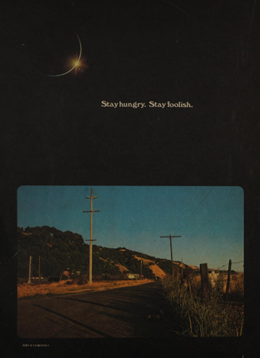
The secret, however, is that this iconic quote was not even Steve’s. During the speech, he explains that he found the words on the back cover of of a seemingly unknown but secretly influential paperback periodical called The Whole Earth Catalog and adopted them as a source of motivation.
“On the back cover of their final issue was a photograph of an early-morning country road—the kind you might find yourself hitchhiking on if you were so adventurous. Beneath it were the words “Stay hungry. Stay foolish.” It was their farewell message as they signed off.”
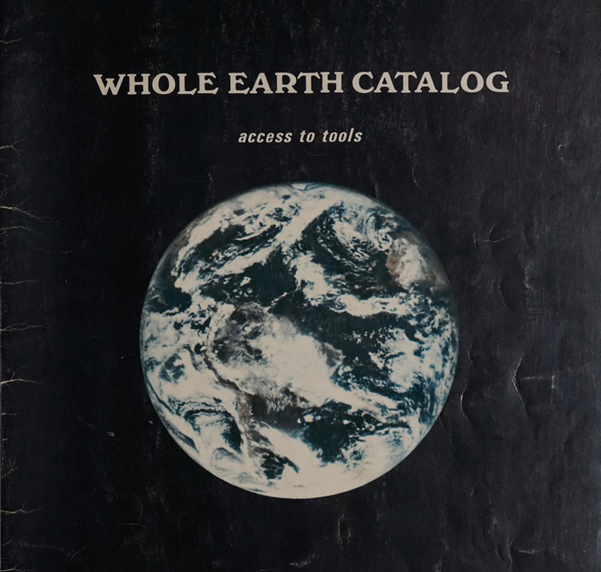
Founded in 1968 by Stewart Brand, during what we would now call the counterculture movement; a moment in history characterized by the rise of “hippie culture” marked by bohemian experiments, psychedelic experiences, anarchist tendencies, Buddhist sensibilities, and, why not, computational enthusiasts. It is, in fact, within this context that a series of dropouts and rebels came to form the founding pillars of what is now known as Silicon Valley. This simple publication, the Whole Earth Catalog, was made by such people and aimed precisely at them. It presented itself as an editorial platform focused on self-sufficiency, ecology, alternative education, “do it yourself” (DIY), and an overall extremely holistic philosophy. A compact yet remarkably rich and diverse tool, costing only about five dollars. It would, in fact, later be considered by Jobs as "a sort of Google in paperback form, before Google came along."
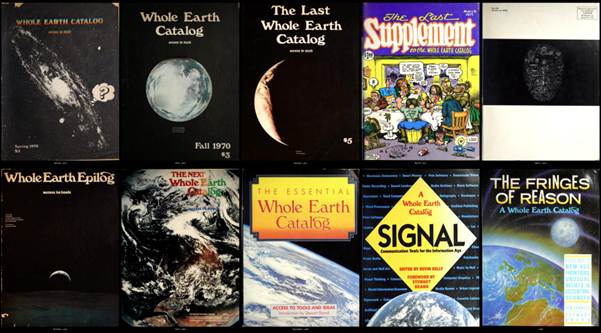
The connection to the Apple’s mastermind is, however, the least interesting thing about this magazine. The name itself was given after the founder campaigned against NASA in 1966, asking why no images of the whole Earth had been released yet, especially after all the space exploration that had been happening in the second half of the 60’s. NASA answered back by releasing the first-ever public photos of our planet seen from space. Each image will be used on most of the front covers of this catalog.
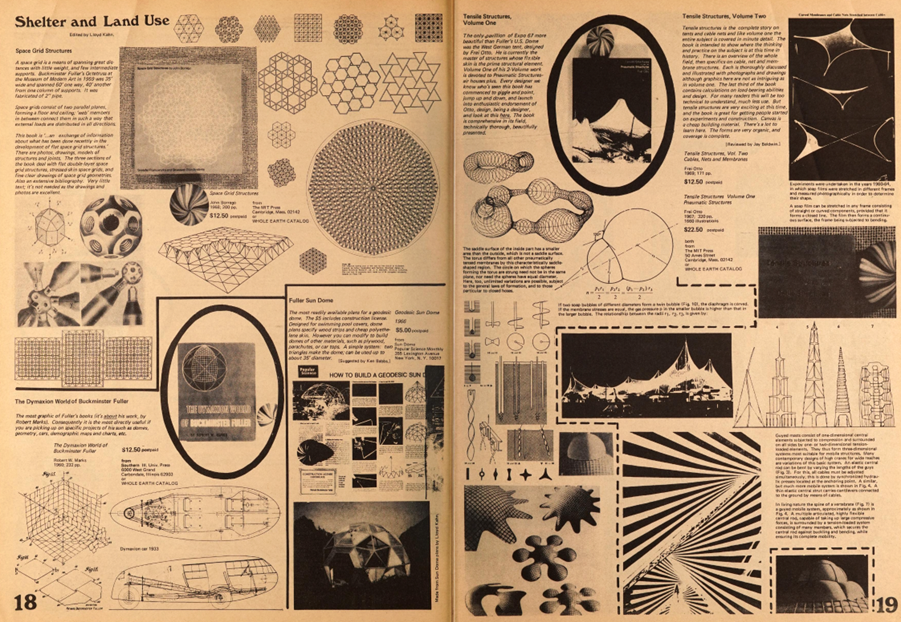
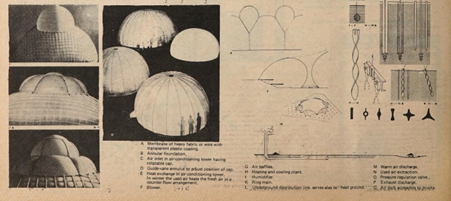
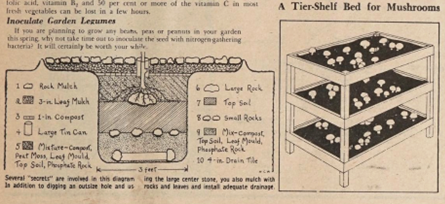
Ranging from instructions for building your own tear-shelf bed for growing mushrooms and constructing an Indian tipi, to discussions of a new book on Japanese houses, recommendations on which sandwich spreader to buy, and presentations of Buckminster Fuller’s domes and their roots in nature’s geometries, it can indeed be considered a bible on “how to do stuff”. These examples are drawn from only the first issue. The richness and diversity of its content is possibly unsurpassable, which makes it easy to see why it has inspired so many inventors and designers.
Although being a bit “all over the place” in its contents, within the first ever issue from the fall of 1968 there’s a simple sentence clearly expressing it’s main function:
“…an evaluation and access device. With it, the user should know better what is worth getting and where and how to do the getting.”
And an object was deemed worth it and therefore publishable only based on a few selected conditions
An item is listed in the CATALOG if it is deemed:
- Useful as a tool,
- Relevant to independent education,
- High quality or low cost,
- Not already common knowledge,
- Easily available by mail.”
Finally the ending purpose was to enable people to build their own personal and intimate education, to inspire and gradually to physically and consciously create things, without disrupting the environment around us:
“We are as gods and might as well get good at it. So far, remotely done power and glory-as via government, big business, formal education, church-has succeeded to the point where gross defects obscure actual gains. In response to this dilemma and to these gains a realm of intimate, personal power is developing-power of the individual to conduct his own education, find his own inspiration, shape his own environment, and share his adventure with whoever is interested. Tools that aid this process are sought and promoted by the WHOLE EARTH CATALOG”.
The magazine was issued several times a year consistently from 1968 to 1977, and sporadically until the last ever issue in 1998.
Now, in 2026, the catalog is no longer printed. Yet, in the midst of AI and the vast information available on the web, it still serves as a grounding tool. It’s a reminder to be conscious of what we bring into this world, and to learn from and be inspired by the diversity around us: different cultures, nature, and already existing objects.
You might think it is now a distant, forgotten collectible paperback. But good news for you! The entire archive is now online for you to get inspired!
Here is the link: https://wholeearth.info/